
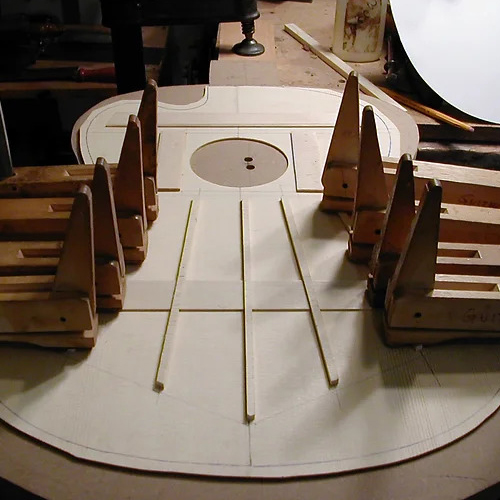
Chapter 7 – Soundboard Bracing
Author’s commentary, suggestions, musings and selected reader’s queries
Kasha Bracing
Does the Kasha bracing system actually work in a way that is noticeable or could the results be down to variations in the top wood, bracing density, etc.? in plain English, is it that much different to warrant further investigation?
I’m not an advocate of the Kasha system, so I’m not the best source of detailed information on it. In an effort to mainstream his concept, Michael Kasha (1920-2013) personally extolled the system’s virtues for four decades and through a handful of zealous advocates–most notably the great Illinois luthier Richard Schneider. It just did not catch on. Dr. Kasha tried to attach a mantle of scientific respectability to it by submitting the scheme to the Acoustical Society of America, but the scheme failed to get that august body of scientists to take his presentation seriously (I was at a convention of that society where this happened). Why? Because of the quality of his science. He made little more than unsubstantiated claims and anecdotal explanations of why his scheme ought to work, but failed to show any data. You can claim anything, but no scientist will take you seriously without data to back you up.
But luthiers require far less stringent proof. He received a lot of enthusiastic press and lot of earnest followers, but it just did not catch on. A number of audience listening test were performed and it never emerged as a favorite. Schneider and his followers were undaunted, citing the limitations of the listening test protocols as reasons for its not standing out. The ear is the final arbiter, and it apparently just did not meet up to that final test among listeners. As to luthiers, it proved far more complicated to execute than standard systems, without any dramatic increment in sound quality to justify the additional effort.
Now if you’re interested in a radical cutting edge system, take a look at the lattice bracing system, as introduced by the Australian luthier Greg Smallman. Now there’s a noticeable and dramatic improvement in power. I’m experimenting now with transferring the system to steel string tensions. Stay tuned. As for Kasha, I don’t know: if you’re impressed, follow it to where it will take you. But I am not.
I’ve written a more extensive critique of the Kasha phenomenon here